You aren’t hired for what you know about artificial intelligence. You are hired for what you already knew before AI existed.
For a growing number of professionals, side income is no longer about escaping their expertise. It is about extending it into the age of AI.
A side hustle normally means work outside your vocation. What is emerging now is different. An AI world willing to pay you for what you already know.
03 — Definition
The Intellectual Side Hustle is the emerging opportunity for subject matter experts to get paid to train AI. Part-time.
The key words are intellectual and part-time. This is not built around generic hustle. It is built around the decades of expertise that frontier AI labs will pay you for. You fit this work around your own schedule. Not the other way around.
04 — Identity
Human Data Expert:a subject matter expert who uses deep domain knowledge to train artificial intelligence systems, often being paid more than they earn in their current vocation.
“The people AI needs most are often the people who never thought of themselves as part of the AI economy.”
Press signal
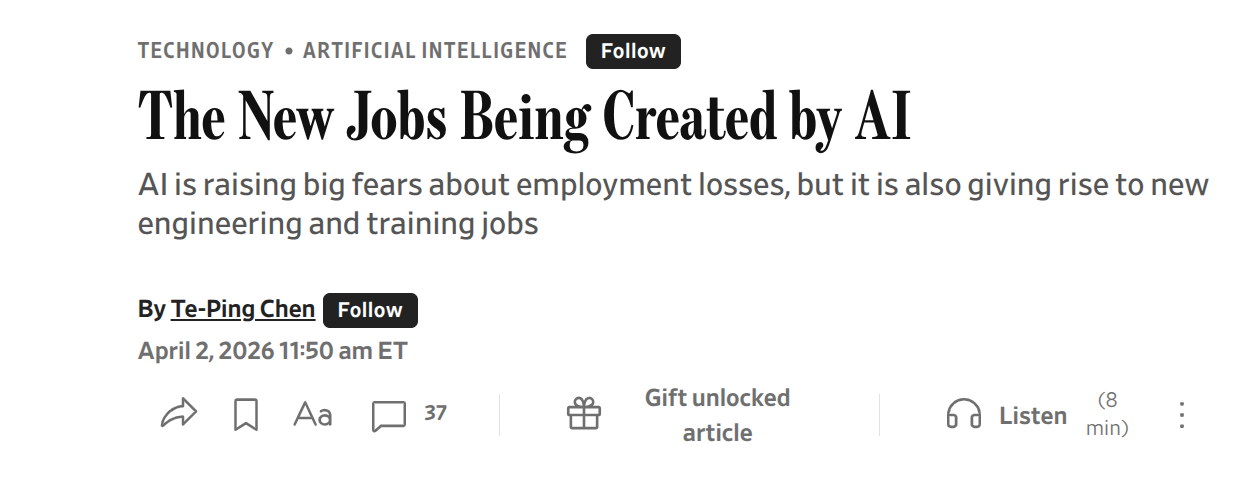
The Wall Street Journal frames AI training jobs as part of the new labour picture.
05 — This is already a functioning market
The strongest proof is not hype.
06 — Role types already emerging
Six distinct role types* are already appearing across the human data ecosystem. And none of them require a computer science degree.
01
The Domain Annotator
Evaluates and labels AI outputs in a specific field. An accountant flagging technical errors in tax advice. A nurse identifying where clinical reasoning breaks down.
02
The Red Team Expert
Actively probes models to find failures that generalists miss. A lawyer finding jurisdictional traps. A chemist spotting dangerous gaps in safety guidance.
03
The Knowledge Architect
Structures expertise by identifying the categories where models consistently fail. You don’t just know the answer. You know why the model got it wrong.
04
The Case-Based Expert
Brings real, anonymised professional scenarios from a career’s worth of experience. Your edge cases are a model’s critical cases. This is the highest value work in the ecosystem.
05
The Generalist Deployment
Hired for how you think, not what you know. Evaluates human dynamics, tone and logic. More common than people expect.
06
The Evaluation Lead
Oversees quality across a team of annotators, designs the rubrics everyone else uses and bridges platforms to clients. Senior work. Senior rates.
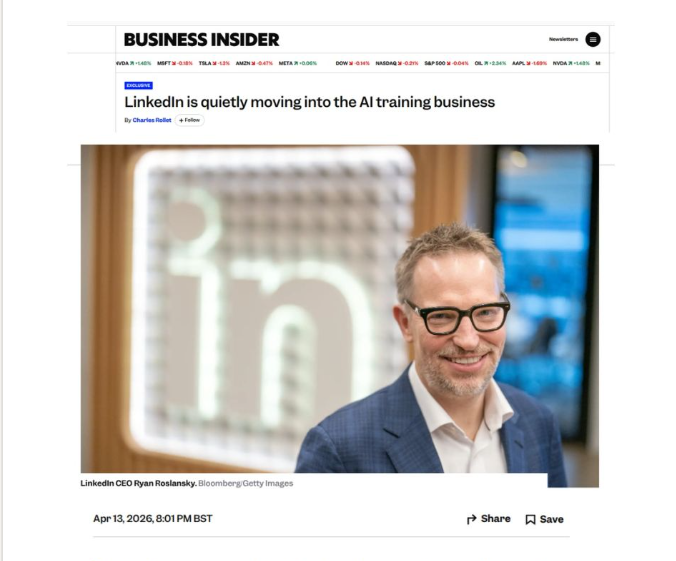
AI training is booming — and LinkedIn wants a piece of the pie, paying up to $150 an hour for people to train AI on coding, nursing, finance and more.
Market signal
This is not a fringe experiment.
LinkedIn described AI training as one of the fastest-growing jobs in the US. It is a category being tested in public by one of the largest professional platforms on earth.
$150/hrTop listed rate
Multi-domainFinance, nursing, coding, linguistics
Uber Is Not Just Hiring Drivers!
Platform signal
Uber AI Solutions shows even familiar platform operators entering skills-based AI work.
08 — Fair questions. Honest answers.
Fair questions.
Question 01
Am I training myself out of a job?
It is a fair concern. But this market exists precisely because intelligent systems still need people who understand how real work is actually done. AI creates pressure, yes. It also creates demand for human judgment in the places where being correct really matters. Your expertise is not the problem. It is the solution.
Question 02
Is the money real?
Sometimes yes, sometimes overstated and often dependent on the platform, the role and the depth of your domain knowledge. The correct approach is discernment. There are real compensation signals and there is noisy marketing. The book helps you tell the difference.
Question 03
Are these platforms legitimate?
Some are serious. Some are messy. Some are excellent for certain profiles and poor for others. A real market can still be uneven. That does not make it fictional. It makes navigation important. The Human Data Platform directory lists over 60 platforms. The book maps them.
Question 04
Can I do this full-time?
Possibly, but unlikely with one platform alone — they operate project by project. The more platforms you are signed up with, the greater the chance of ongoing work. The book shows you how to build that pipeline.
09 — Proof it works. 41 days.
Mucha Murapa is not approaching this category as an outside observer.
Earlier this year he set out to learn everything he could about training AI. It became clear quickly that AI works best when there is a human in the loop — to correct, to train and to input the kind of judgment that machines cannot replicate.
He applied to Micro1, one of the most rigorous human data platforms operating today. The certification process was exacting. They needed to see not just credentials but a body of work — case studies, a demonstrable career, a shop window of real expertise.
He was certified. Added to their talent pool. And then he waited.
On August 15th the email arrived. A client had seen his profile. They were impressed. Was he ready to be onboarded? He was.
Four days later, on August 19th, the first project began. He did four hours of work in that first fortnight. The platform pays every two weeks.
Over 41 days, working part-time and fitting it around existing commitments, the total reached $10,000.
Not a projection. Not a promise. A number from a contract, from a real client, through a real platform.
“I hate side hustles. If you have side hustles, that means your main hustle isn’t working.”
10 — A serious objection
Prof Galloway is right about most side hustles.
He is just not describing this one.
His warning is a responsible one. Many side hustles are exactly what he is criticising. Scattered effort, weak focus and economic activity that looks productive without building real leverage.
But The Intellectual Side Hustle is not a random second hustle layered on top of a struggling primary career. It is the extension of real professional expertise into a new market created by AI.
A lawyer is still using legal judgment. A clinician is still using clinical reasoning. A recruiter is still using assessment skill. What changes is the commercial surface area of that expertise. It becomes portable, visible and newly valuable inside the human data economy.
This is not distraction from mastery. It is mastery finding a second market.
You’ve seen what this is. Now see what it can do for you.
The Intellectual Side Hustle is the book that maps this market properly. The platforms worth your time. The roles that match your background. The mistakes that cost people months. And the approach that took one marketing expert from curious to $10,000 in 41 days.
If you are a professional with decades of real expertise — and you have ever wondered whether that expertise could work harder for you — this is the book that answers that question.